
When selecting an industrial hose, one of the first specifications you look for is the hose pressure rating. It states the hose’s Maximum Working Pressure (MWP) under normal operation. While this is absolutely critical, it’s a common misconception that this number represents the entire hose assembly’s safe operating pressure.
Your system’s true maximum working pressure is influenced by three factors: the hose, the coupling type, and the assembly method.
Overlooking any one of these can lead to dangerous failures, leaks, and costly downtime. Let’s break down why you need to consider the whole picture to determine your assembly’s actual safe working pressure.

Industrial hoses
Hose pressure rating: your foundation
Every hose has a specified Maximum Working Pressure (MWP). This is engineered based on the hose’s construction, materials, reinforcement layers, and diameter. This is the starting point for defining your assembly’s working pressure limit.
Key Consideration: Always select a hose with an MWP that meets or exceeds your application’s maximum operating pressure, including any potential surges.
How couplings change your hose pressure rating in practice
This is where many systems fall short. Couplings are not universal in their pressure capabilities. The following aspects are very important to consider in terms of pressure when choosing a coupling. Of course, there are several other factors that come into play, which we defined in a recent article: coupling selection guide.
- Coupling material & design: A coupling’s material, wall thickness, and design (e.g., cam-and-groove, threaded, flange, quick-disconnect) all contribute to its own pressure rating. A cheap, lightweight coupling, even if it fits the hose, might have a significantly lower pressure rating.
- Sealing mechanism: How the coupling seals (e.g., O-rings, gaskets, metal-to-metal contact) also impacts its ability to hold pressure without leaking.
- Manufacturer specifications: Reputable coupling manufacturers provide specific pressure ratings for their products. Always check these carefully.
- Crucial rule: The working pressure of the coupling should be equal to or greater than the working pressure of the hose. If your hose pressure rating is 16 bar but your coupling is only rated for 10 bar, your assembly is only safe to 10 bar.

Couplings
Assembly methods and their impact on working pressure
Even with a perfectly matched hose and coupling, an improper assembly method can reduce the entire system’s pressure integrity. The way a coupling is secured to the hose determines its ability to resist “blow-off” under pressure. A professionally assembled hose ensures that the coupling is securely attached, distributing stress evenly and allowing the entire assembly to perform at its maximum safe working pressure.
Crimping
This method uses a machine to compress a metal ferrule or sleeve around the hose and coupling. A precise crimp ensures optimal grip without damaging the hose. An incorrect crimp (too loose, too tight, wrong die) can create weak points.
Flaring (PTFE hoses)
With this method, the PTFE liner of the hose is flared out through the coupling. The fitting is designed so the flared liner forms the sealing surface. This ensures a continuous, smooth PTFE lining throughout the hose assembly — the fluid only contacts PTFE, not the metal coupling.
Banding/clamping
Using external bands or clamps (e.g., worm gear clamps, bolt clamps) is common for lower-pressure applications. The number, type, and tension of these clamps are critical. Using too few, the wrong type, or overtightening can compromise the hose.
Safety clips/pins
For certain coupling types (like cam-and-groove), safety clips or pins are essential to prevent accidental disengagement, which is particularly vital under pressure.
Putting it all together: your actual safe working pressure
To determine the true maximum working pressure of your hose assembly, you must consider the lowest pressure rating among these three components:
- Hose Pressure Rating
- Coupling Pressure Rating
- Pressure integrity based on the Assembly Method (e.g., what the coupling-to-hose bond can withstand)
For example: The hose pressure rating is 16 bar, the coupling pressure rating is 10 bar, the assembly is rated for 5 bar for that specific hose/coupling combination. Your actual safe working pressure for this assembly is 5 bar. Operating above this significantly increases the risk of failure.
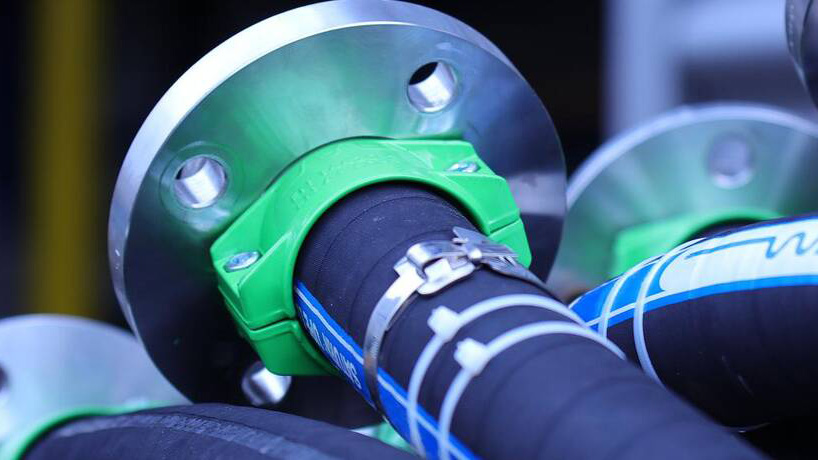
Fitted hose manufacturing
The IzoflexHose advantage: expertise in system integrity
Understanding these interconnected factors is critical for safety and operational efficiency. At IzoflexHose, our experts don’t just sell you components; we engineer complete solutions. We meticulously match hoses, couplings, and apply professional, compliant assembly methods to guarantee your fluid transfer system performs reliably and safely, even under demanding pressure conditions.
Need help validating your hose pressure rating and assembly limit? Talk to IzoflexHose engineering.

